Why are crypto address labels so expensive? Will AI agents bring the price down?
Labels are expensive because they answer one question: who is actually behind this anonymous address? Expanding from a few reliable seeds, with AI agents doing the querying and checking, will bring down the cost of producing the common ones.
Looking up the label for a crypto wallet address is actually expensive.
An ordinary subscription usually costs a few hundred dollars a month, and professional investigation and compliance products can run to a thousand or several thousand. For someone who only wants to check an address now and then, the price is hard to understand: every on-chain transaction is public, so why does putting a name next to an address cost so much?
Because what’s valuable isn’t the few words themselves. It’s the answer to one question: who is actually behind this anonymous string of characters?
Labels are the compass of the crypto world. Without them, all you see is money moving between addresses. With them, you can tell whether funds are flowing to an exchange, a payment platform or a project team, or into a scam, hacking or money-laundering network. Whether for investment research, on-chain investigation or anti-money-laundering work, this is a basic need.
Why labels have always been expensive
In the past, producing labels relied mainly on people and intelligence.
An address doesn’t announce “I’m a wallet belonging to such-and-such exchange.” Analysts have to find announcements, check public information, follow the money, and then look for related wallets in behavior such as deposits, consolidation and payouts. A conclusion can’t rest on a single transfer either; it has to be verified again and again against amounts, timing, shared counterparties and where the money goes next.
The data itself is another barrier. Public chains are open, but looking at one transaction and analyzing billions of them are entirely different things. The data has to be downloaded, parsed, indexed and stored, and someone has to be able to write the queries and understand how each chain structures its data.
And labeling isn’t a one-time job. Exchanges change wallets, projects migrate contracts, and illicit actors keep moving funds. Old labels need updating, and new addresses need tracking.
The price of labels has essentially covered the cost of human analysis, intelligence gathering, whole-chain data processing and ongoing maintenance. That work is complex and slow, so labels were never going to be cheap.
A few seed addresses can grow a whole field of labels
Label mining has one important property: it isn’t one piece of human work per address.
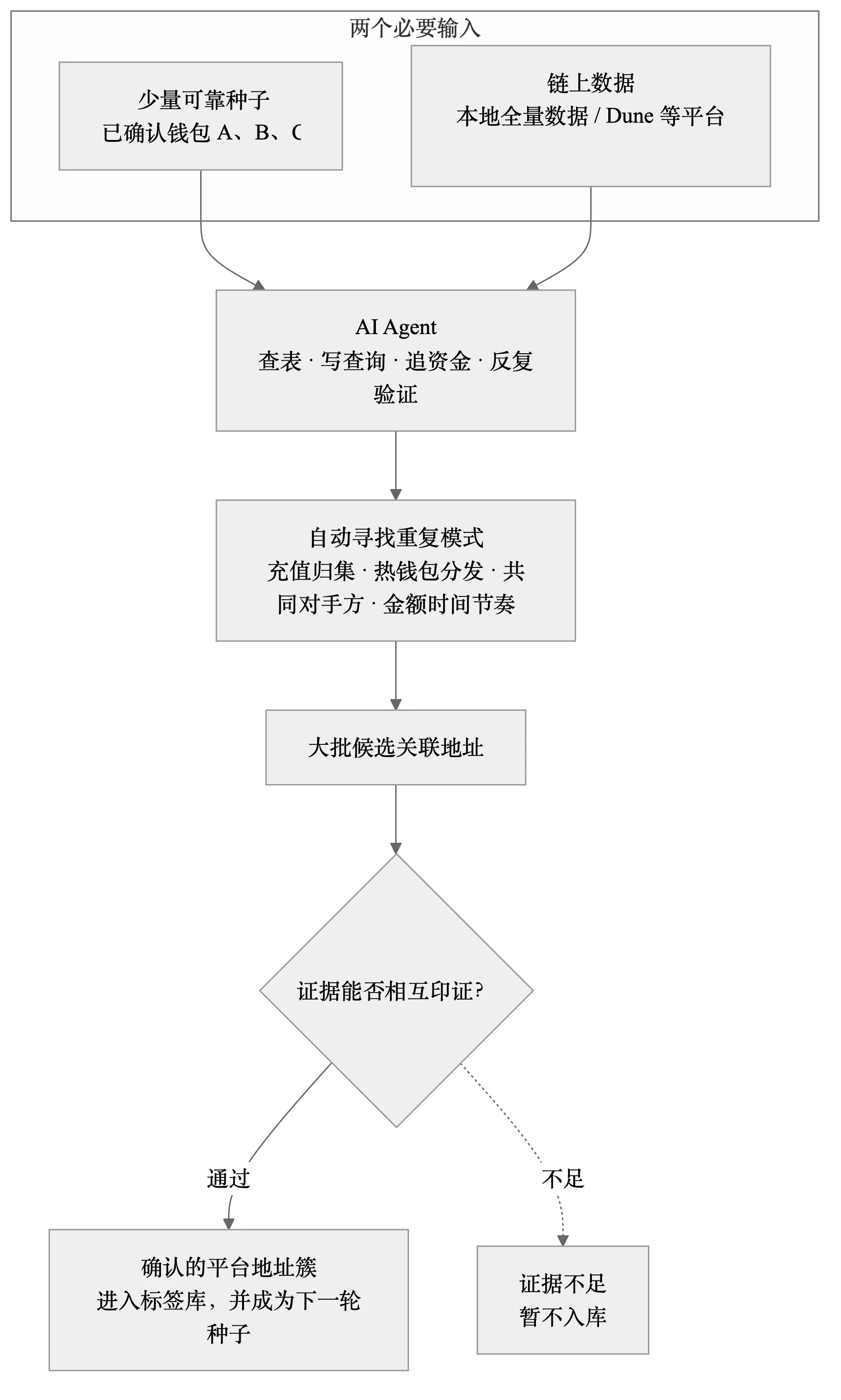
Suppose a few wallets have already been confirmed as belonging to a particular exchange. They usually don’t exist in isolation; they have steady relationships with large numbers of deposit addresses, consolidation wallets, hot wallets and fee addresses.
Which addresses keep consolidating into the same wallet? Which wallets have similar deposit and withdrawal rhythms? Which addresses repeatedly interact with known hot wallets? Put these patterns together and a small number of known addresses can surface a large batch of candidate addresses.
A reliable seed label is worth more than one address — it can be the entry point to an entire cluster of addresses.
PoR addresses make excellent seeds. To prove their reserves, exchanges publish a set of wallet addresses they control. Existing practice has shown that starting from these public PoR addresses, and combining on-chain consolidation structure with verification against third-party labels, it is possible to expand to exchange address labels numbering in the millions.
That doesn’t mean every address found this way can be confirmed directly. A platform may use third-party custody, one-time addresses, or keep changing wallets, so cross-checking evidence is still needed at the end. But it does show that labels don’t have to be collected by hand one at a time; they can be expanded in bulk from a small number of reliable seeds.
AI agents change how efficiently labels are mined
The principles of label mining aren’t that mysterious. What takes time is finding material, finding the right data tables, writing queries, checking results, adjusting conditions, rerunning, continuing to trace, and finally organizing the evidence.
In the past, this process depended mainly on algorithm engineers and analysts working together. Algorithms would filter out candidate addresses, and people would check them batch by batch. Once the data got large, everything slowed down.
This continuous, fiddly work is exactly what AI agents are suited for. An agent can read public intelligence, generate queries around seed addresses, adjust conditions based on the results, group candidate addresses, and then organize the source and evidence for every conclusion. Analysts no longer need to do every step by hand; they only need to provide seeds, set the rules, and review the key results.
Work that used to take algorithms plus a great deal of manual checking can now be run continuously by an agent, concentrating human effort on the few places that genuinely need judgment.
The data barrier is falling too. Teams with complete on-chain data can have an agent query their local database directly; teams without local data can use platforms such as Dune. An agent can find the data tables, write the queries and run the analysis itself, so a team no longer has to build an expensive whole-chain data warehouse first.
Label prices should come down
Labels won’t become free. Reliable seed intelligence, human review and continuous updates still have value, and some exclusive intelligence will stay expensive.
But for most labels covering common exchanges, payment platforms and stable behavioral patterns, the cost of production will fall noticeably as agents become widespread. The same mining workflow can be run again and again, and one reliable seed can expand into a large number of candidate addresses, so the human effort needed per label will keep shrinking.
The way labels are bought will change as well. Where you once had to buy a whole system or an annual subscription, in future it may increasingly be an API, pay-per-address, pay-per-query, or even an agent mining labels on the spot when they’re needed.
AI agents won’t make intelligence worthless, but they will greatly raise the efficiency of producing labels, and ultimately bring label prices down.
The real competitive edge will gradually shift from “how many labels you have stored” to “whether you can get reliable seeds, expand address networks quickly, and keep evidence for every conclusion.”
If you’re also working on on-chain investigation, crypto risk control or building address labels, feel free to get in touch.
Sources
- Introducing the Dune MCP
https://dune.com/blog/dune-mcp - Dune agents
https://dune.com/agents